Why Virtual Assistants Need a Professional Portfolio Website
Before a client books a call with you, they look you up. They check your LinkedIn, your profile on job boards, and they search your name. What they find in those few minutes often decides whether they reach out.

A professional portfolio website gives them one clear place to land. It shows who you are, what you do, and the results you have delivered. For a Virtual Assistant, it is often the difference between being one of many applicants and being the one they remember.
1. Why Does a VA Need a Portfolio Website?
A portfolio is more than a gallery of tasks you have done. It shows your purpose, the problems you solve, and the value you add to a client's business. Clients are not buying hours of admin work. They are buying time back, less stress, and things done right.
"People don't buy what you do; they buy why you do it." Simon Sinek, Start With Why
Your website is where that "why" lives. A job board profile follows the platform's template, and so does everyone else's. Your own site lets you tell your story your way: the clients you love working with, how you work, and what changes when they hire you.
It also works for you around the clock. While you sleep in Manila or Dubai, a client in New York can read your services, see your samples, and book a discovery call.
2. Own Domain vs Free Hosting
Many VAs start with a free website builder, and that is fine for a first draft. But once you are pitching real clients, your own domain sends a stronger signal. Compare the two:
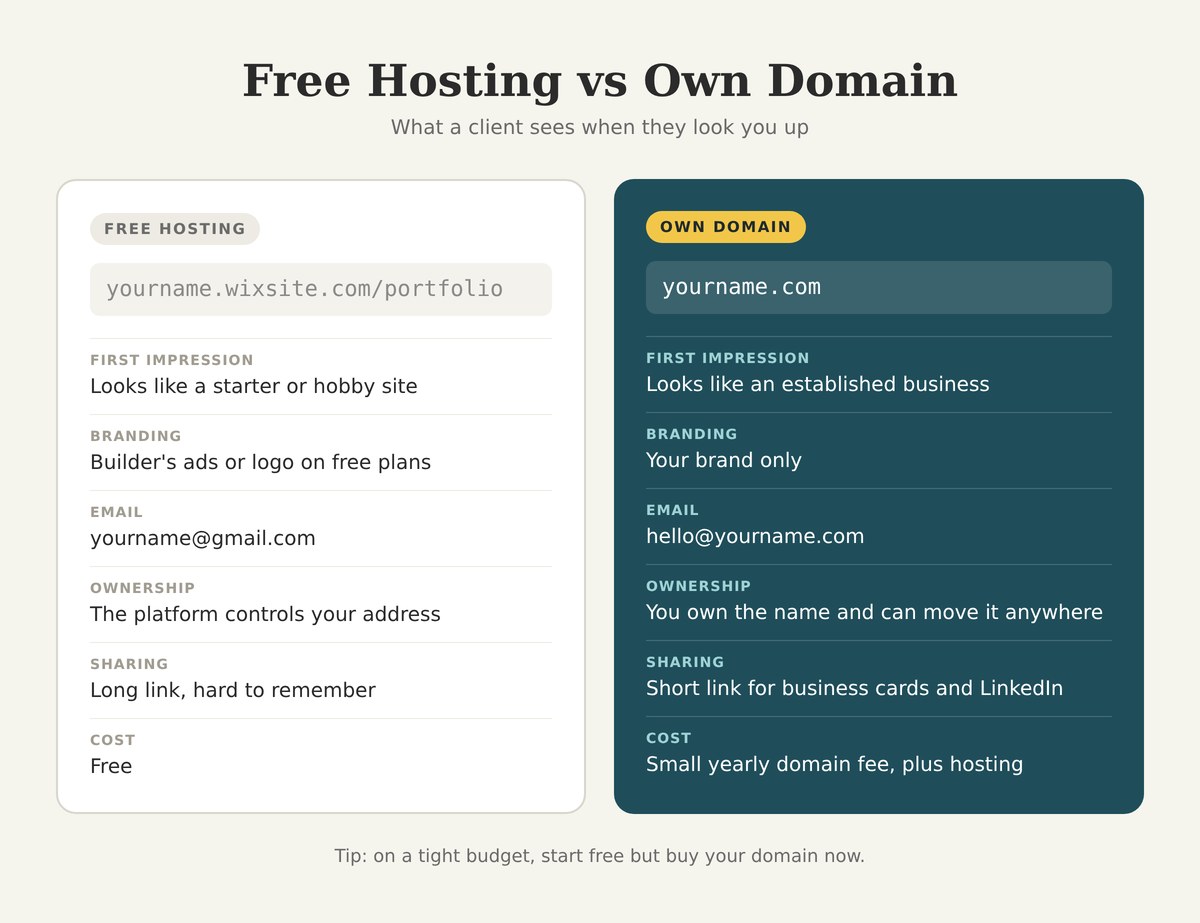
Free hosting
- Web address: yourname.wixsite.com/portfolio
- First impression: looks like a starter or hobby site
- Branding: free plans often show the builder's ads or logo
- Email: yourname@gmail.com
- Ownership: the platform controls your address
- Sharing: long link, hard to remember
Own domain
- Web address: yourname.com
- First impression: looks like an established business
- Branding: your brand only
- Email: hello@yourname.com
- Ownership: you own the name and can move it anywhere
- Sharing: short link, easy to put on a business card or LinkedIn
Think of it this way. A client trusts you with their inbox, their calendar, and sometimes their finances. A short, clean web address and a matching email show that you take your own business seriously too.
"In a crowded marketplace, fitting in is failing." Seth Godin, Purple Cow
The VA market is crowded. A free subdomain blends in. Your own domain is a small investment that helps you stand out.
Tip: A domain usually costs a small yearly fee, plus a hosting plan. If it helps you land even one client, it has already paid for itself.
3. What to Put on Your Portfolio Website
Once you have your domain, the next step is a site that attracts your ideal clients. Here are the strategies that matter most.
Start with a clear focus. Decide who you want to serve before you design anything. A VA for real estate agents needs a different site from a VA for e-commerce brands. Organize your services around that client.
"Begin with the end in mind." Stephen R. Covey, The 7 Habits of Highly Effective People
Group your work into categories. Use clear sections such as Administrative Support, Social Media Management, Inbox and Calendar, and Customer Service. This helps clients find what they need in seconds.
Tell the story of each project. For every sample, answer three questions. What problem did the client have? What did you do? What changed? Add numbers where you can, like hours saved per week or response time cut in half. Testimonials from real clients make this even stronger.
"Be so good they can't ignore you." Steve Martin, quoted in Cal Newport's So Good They Can't Ignore You
Keep it simple and consistent. Use the same colors, fonts, and photo style across every page. Make sure it loads fast and looks good on a phone. Write short, clear lines, and always include an easy way to book a call.
"Omit needless words." William Strunk Jr., The Elements of Style
4. Grow Your Portfolio With a Growth Mindset
Psychologist Carol Dweck describes two ways people see their abilities. With a fixed mindset, you believe your skills are set. With a growth mindset, you believe they grow through effort and learning. Your portfolio website should reflect the second.
"Becoming is better than being." Carol S. Dweck, Mindset: The New Psychology of Success
Treat your site as a record of who you are becoming. Every month or two, add a new project, update a testimonial, remove outdated work, and refresh your services and rates. A site that keeps growing shows clients that you are learning, improving, and ready for bigger work.
Tip: see every new skill and every setback as a chance to grow. Learned a new tool or AI assistant? Add it to your site. Had a project that didn't go to plan? Fix your process, then share what you improved.
Your Website as a Reflection of Your Purpose
Your portfolio website shows what you do, but it also shows who you are and why you do it. A clear focus, a professional domain, real results, and regular updates turn a simple site into your best sales tool.
If you are still on a free subdomain, this is your sign. Claim your name, tell your story, and give clients one place to say yes.